
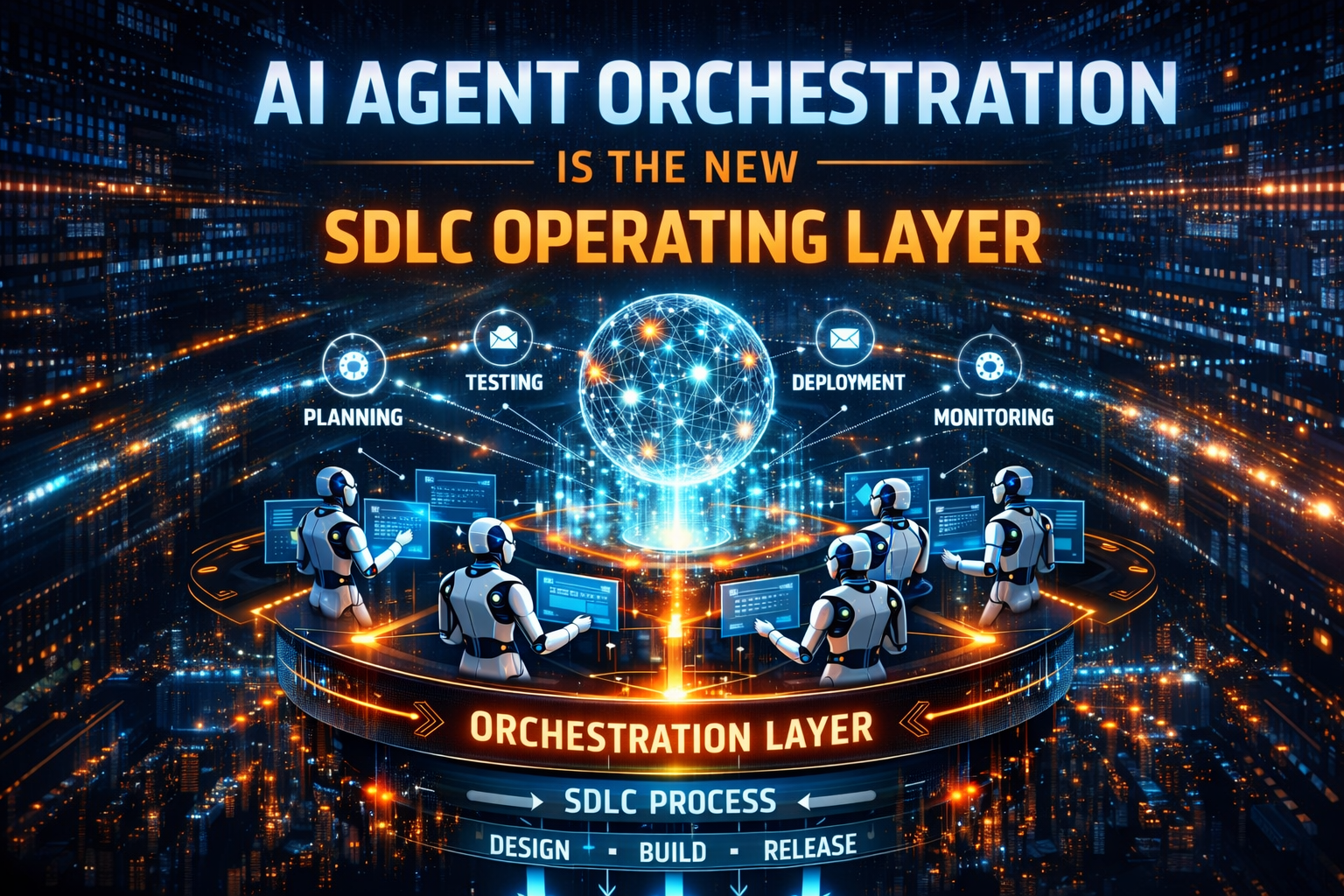

The trajectory of Artificial Intelligence in software engineering has fundamentally shifted. Large Language Models (LLMs) are rapidly moving past their initial role as passive intelligent assistants—providing context-aware suggestions and sophisticated autocomplete—to become collaborative, autonomous partners operating within the core Software Development Lifecycle (SDLC). This evolution is not merely an improvement in developer tooling; it represents the definitive arrival of AI as an operating layer, forcing senior software organizations to immediately re-evaluate foundational architecture, security practices, and quality standards.
The thesis is clear: The emergence of Autonomous Multi-Agent Systems, orchestrated to plan, execute, and deploy substantial software tasks in parallel, necessitates an immediate, structural overhaul of existing infrastructure. This orchestration layer is the new foundation of development velocity.
TECHNICAL DEEP DIVE
The core mechanism enabling this architectural pivot is the decomposition of complex software requirements into interdependent, scoped responsibilities delegated across a parallel multi-agent system. This moves beyond simple function calling by a single LLM instance. Instead, the workflow leverages specialized agents that coordinate through a centralized, shared task planning and memory mechanism.
Under the hood, an orchestrated multi-agent system operates on several key principles:
- Task Decomposition and Delegation: A primary Orchestration Agent interprets high-level natural language requirements (the user story or epic) and systematically breaks them down into discrete, executable sub-tasks. It delegates these sub-tasks to specialized peers (e.g., an Architecture Agent for design proposals, a Code Generation Agent for implementation, or a Testing Agent for verification).
- Shared Ephemeral Memory: Coordination is managed via a shared working memory—often a proprietary, vector-optimized database or knowledge graph—that acts as the system’s “scratchpad.” This memory stores the current system state, architectural constraints, generated artifacts (code snippets, test cases), and crucial audit logs of each agent’s reasoning chain. This shared context allows parallel agents to avoid collisions and leverage the outputs of their peers without relying solely on long, token-intensive prompt histories.
- Execution Sandboxing: Because agent actions are inherently non-deterministic, safety is enforced through isolated, dedicated execution sandboxes (ephemeral environments). These sandboxes provide the necessary tooling (compilers, interpreters, access to dependencies) but strictly constrain resource access based on the agent’s defined policy. This infrastructure tooling is essential to manage agent sprawl—the volatility and rapid proliferation of non-deterministic processes.
This architecture enables true autonomous project execution. For instance, the Testing Agent can generate a suite of test cases based on the initial requirements, and the Code Generation Agent can then write code intended to pass those tests, all before human supervision intervenes for final approval.
PRACTICAL IMPLICATIONS FOR ENGINEERING TEAMS
The implementation of an AI operating layer directly impacts three critical domains: infrastructure, developer skills, and product strategy.
Impact on CI/CD and System Architecture
Continuous Integration/Continuous Deployment (CI/CD) pipelines must integrate an Agent Policy Layer as a non-negotiable security and compliance checkpoint. This layer provides necessary permissions, audit logs, and guardrails to manage the risks associated with autonomous code execution.
- Policy Enforcement: Every code commit or deployment artifact generated by an agent must be filtered through a policy check that verifies adherence to system constraints, resource limits, and defined security patterns. This replaces traditional static analysis with a dynamic reasoning-based audit.
- Telemetry and Evals: Rigorous evaluation frameworks (evals) become essential for Quality Control (QC). Unlike human-written code, which relies on unit tests, agent-generated code requires functional, performance, and security evals that assess the agent’s intent versus the result. Telemetry must track the agent’s decision-making process to ensure reliability and auditability against subtle but critical errors (hallucinations).
- Architectural Shifts: Product managers and tech leads must shift focus from optimizing complex UI/UX to transforming the product into a robust, clean workflow engine. The defensible moat is no longer simple user interface design but proprietary data sets and system APIs that agents can reliably execute against.
Skill Shift for Developers and Tech Leads
The required skill set is shifting dramatically. The mechanical act of writing boilerplate code is being abstracted away, prioritizing higher-level conceptual thinking.
- Conceptual Design: Developers become supervisors and constraint definers. Their primary task moves from writing implementation to defining system boundaries, creating the policy layer, and architecting the overall multi-agent workflow.
- Debugging the Mind: Debugging now involves analyzing the trace and reasoning chain of the agents (the “mind”) rather than just the resulting code. This requires proficiency in interpreting agent logs and managing model behavior, a skill distinct from traditional software debugging.
CRITICAL ANALYSIS: BENEFITS VS LIMITATIONS
The transition to orchestrated agent systems offers dramatic competitive benefits but introduces significant technical trade-offs that demand cautious infrastructure investment.
Benefits
- Compounding Velocity: By deploying models inside the pipelines that train, test, and ship the next generation of models, the systems create a compounding effect on development velocity. Iteration speed increases dramatically.
- Full Lifecycle Automation: Agents can automate the entire lifecycle, from natural language requirement interpretation to deployment, reducing human intervention to supervision and constraint definition.
- Parallel Efficiency: The use of parallel, specialized agents allows for high concurrency in execution, significantly reducing overall development cycle time, especially for large, complex feature implementation.
Limitations and Trade-Offs
- Non-Deterministic Reliability: The primary limitation is the inherent non-determinism of LLMs, making autonomous systems prone to subtle errors or logical flaws that are harder to detect than traditional bugs. This requires massive compute overhead dedicated to rigorous, redundant evaluation (evals) and testing to ensure quality.
- Infrastructure Overhead: The architectural requirements—specialized databases for shared memory, robust sandboxing for execution, and comprehensive Agent Policy Layers—demand immediate, substantial infrastructure investment. These systems increase both the complexity and the compute cost of the development environment.
- Security Complexity: Allowing autonomous systems to operate with execution and deployment privileges heightens the security surface area. Managing access permissions and auditability for dozens of parallel, self-directed entities is exponentially more complex than auditing a handful of human developers.
- Debugging Difficulty: Debugging emergent behavior across a chain of coordinated agents is a nascent field. Failures are often not traceable to a single line of code but to a flaw in the initial conceptual prompt or the interaction protocol between agents, posing a steep learning curve for existing engineering teams.
CONCLUSION
AI Agent Orchestration is the structural layer defining the next era of the SDLC, shifting the focus of software engineering away from mechanical coding and toward system supervision and constraint definition. This move signals a strategic repositioning where AI is the primary execution engine.
Over the next 6-12 months, organizations must prioritize infrastructure investment in two critical areas: specialized databases for managing agent memory and state, and robust Agent Policy Layers for governance, security, and auditability. Those organizations that treat AI merely as a feature will rapidly fall behind in terms of development velocity and complexity management. The trajectory is toward standardized communication protocols between heterogeneous agents and achieving production-grade stability in these non-deterministic environments. The immediate challenge is not writing better code, but architecting a secure, auditable system where code is generated by autonomous collaboration.
Leave a Comment