
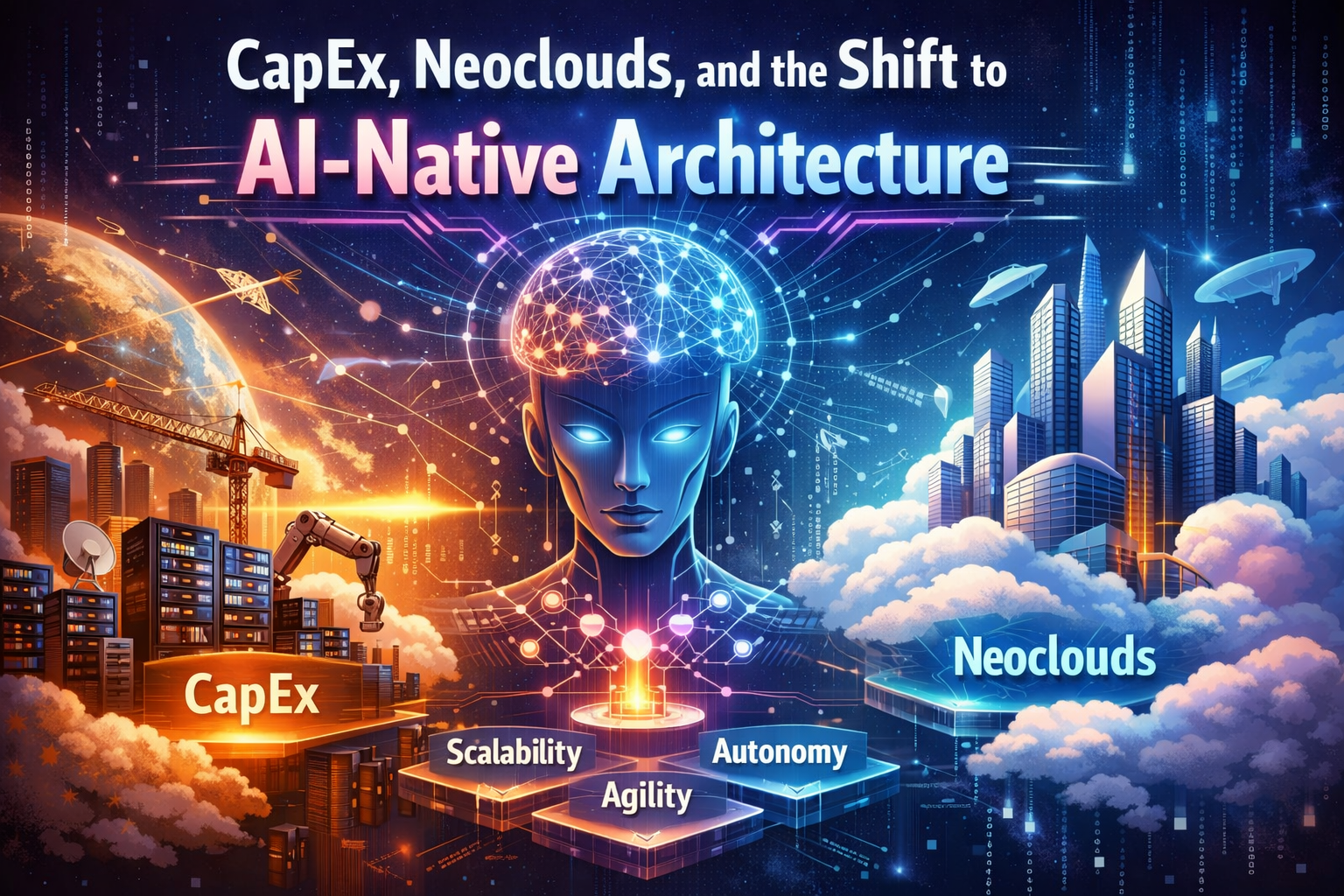

The global computing infrastructure is undergoing a foundational pivot, driven not by a new software release or a marginal efficiency gain, but by the colossal financial commitments of major technology providers. When hyperscalers like Meta Platforms announce capital expenditure (CapEx) guidance reaching up to $135 billion for 2026, primarily earmarked for “Meta Superintelligence Labs” and proprietary silicon, it signals an infrastructure shift of unparalleled magnitude. This massive investment wave, supported by aggressive spending from Microsoft in Intelligent Cloud and Azure, and strategic backing for specialized providers, validates a technical thesis: the era of general-purpose cloud computing is yielding to an AI-native architecture.
This transition is critically important right now because these financial decisions dictate the underlying economics, resource allocation, and architectural constraints for every piece of software built over the next decade. The core challenge for Senior Engineers and Tech Leads is shifting from the conventional scale-out paradigm, which prioritized CPU-centric uniformity, to one that prioritizes heterogeneous, GPU-centric resource orchestration. The failure to immediately adopt AI FinOps practices and architect explicitly for this new environment will result in unsustainable costs and significant competitive disadvantages.
TECHNICAL DEEP DIVE
The mechanism driving the shift to AI-native architecture is the fundamental restructuring of the data center around the GPU and high-speed, low-latency fabric interconnects. Traditional cloud infrastructure relies heavily on horizontal scaling across general-purpose virtual machines (VMs), optimizing for flexibility and virtualization across CPU cores. AI-native architecture, conversely, optimizes for matrix multiplication and high-throughput parallel processing, which are the domain of the Graphics Processing Unit (GPU) and Application-Specific Integrated Circuits (ASICs).
This restructuring manifests in two primary ways:
- Distributed Compute Fabric (DCF): Unlike general-purpose workloads where application locality is crucial, AI workloads—particularly large language model (LLM) training and inference—require massive, coordinated pools of compute. The DCF replaces traditional Ethernet topologies with ultra-low-latency, high-bandwidth interconnects, such as InfiniBand or specialized proprietary fabrics. For instance, technologies like NVLink allow multiple GPUs within a single node, or across a cluster, to function as a unified memory space, mitigating bottlenecks associated with PCI-E bandwidth and enabling true model parallelism (sharding the model across devices) and data parallelism (replicating the model and splitting the input data). The architecture moves the networking boundary closer to the silicon.
- The Rise of the Neocloud: This term describes specialized cloud environments built from the ground up to host these DCFs, exemplified by providers like CoreWeave, which have secured significant backing (such as Nvidia’s $2 billion investment). A neocloud differentiates itself by focusing almost exclusively on high-density GPU clusters and providing granular resource allocation for AI workloads. They are not merely hyperscalers offering GPU SKUs; they are architects of the AI factory. This specialization allows for the deployment of custom kernel optimizations and resource scheduling algorithms specifically tailored for CUDA and comparable parallel frameworks, achieving utilization rates and performance stability (low P99 latency) unattainable in a general-purpose public cloud.
PRACTICAL IMPLICATIONS FOR ENGINEERING TEAMS
The emergence of AI-native infrastructure and neoclouds demands immediate, tactical changes in how software is designed, deployed, and managed. The technical strategy for Senior Engineers must prioritize optimization and resource orchestration over mere availability.
- FinOps for Intelligence: The cost structure of GPU utilization is fundamentally different from CPU utilization. GPU time is far more expensive, but idle time is exponentially wasteful. Tech leads must integrate sophisticated visibility tools to track resource consumption per inferencing request, per microservice, or per training run. The economics of intelligence reward precision; organizations lacking visibility into how AI workloads consume resources risk significant overspending. This requires incorporating unit economics into every feature roadmap.
- Architecture Design and Orchestration: We must move away from monoliths or simple CPU-backed microservices to applications defined as pools of AI-optimized microservices. The traditional concern of data locality is superseded by resource orchestration. A single user request may fan out to an expensive, latency-tolerant training service running on a neocloud, a low-latency inferencing service running on a hyperscaler Edge location, and a CPU-bound business logic service on premise. Kubernetes remains the orchestration layer, but the scheduler must be deeply aware of specialized resources (e.g., node selectors targeting specific GPU memory sizes, interconnect topologies, or custom accelerators) and capable of hybrid environment management.
- Infrastructure-as-Code (IaC) and Policy: The inherent complexity of hybrid environments—managing custom silicon on-premise, specialized capacity on a neocloud, and generalized services on a hyperscaler—necessitates strict standardization on Infrastructure-as-Code and Policy-as-Code. Tools like Terraform, Pulumi, and Open Policy Agent (OPA) must be used not just for deployment, but for capacity management and cross-vendor policy enforcement. This automation provides the necessary context for future AI-assisted operations (AIOps), ensuring consistency and security across disparate infrastructure domains.
- Vendor Strategy Diversification: The default strategy of deploying all services on a single hyperscaler is now fiscally irresponsible for AI-intensive workloads. Tech teams must evaluate model deployment across hyperscalers, neoclouds, and edge/on-device platforms. For example, large-scale model pre-training might be most economical on a neocloud optimized for massive, burstable GPU clusters, while high-volume, low-latency inferencing is best suited for the global distribution of a major hyperscaler. This vendor diversity is not about mitigating general risk, but about leveraging specialized resource pricing for cost efficiency.
CRITICAL ANALYSIS: BENEFITS VS LIMITATIONS
The shift to AI-native architecture offers compelling technical advantages but introduces significant friction points related to vendor dependency and operational complexity.
Benefits:
- Performance Density: The DCF architecture significantly improves performance metrics crucial for AI. It reduces p99 latency for model inference by eliminating traditional I/O and networking bottlenecks, allowing for real-time applications that were previously impractical. The increase in GPU density and utilization translates directly into faster training cycles and lower long-term operational costs per operation.
- Cost Optimization (Selective): While CapEx is massive, the availability of specialized neoclouds allows organizations to access state-of-the-art AI infrastructure without absorbing the capital burden themselves. This is particularly beneficial for startups and mid-market companies needing access to cutting-edge compute that would otherwise require building proprietary data centers (e.g., accessing large H100 or proprietary silicon clusters).
Limitations and Trade-offs:
- Vendor Lock-in and Proprietary Stacks: The reliance on high-performance fabric (like NVLink) and proprietary silicon (Meta’s custom chips, Microsoft’s deep investment in custom Azure infrastructure) drastically increases vendor lock-in. Optimization at the kernel and accelerator level means abstracting away the hardware layer becomes nearly impossible, forcing engineering teams into tightly coupled, hardware-aware development practices.
- Operational Complexity: Managing a hybrid AI estate across hyperscalers, neoclouds, and local data centers exponentially increases the complexity of observability, security, and resource scheduling. Integrating disparate monitoring tools and maintaining consistent security policies across varied cloud environments is a non-trivial operational challenge.
- Talent Scarcity: The specialization required—proficiency in distributed computing, GPU programming (CUDA/HIP), FinOps modeling, and hybrid cloud orchestration—demands a highly skilled and scarce technical workforce. Scaling AI operations will be limited by the availability of specialized engineering talent, not just hardware capacity.
CONCLUSION
The unprecedented CapEx guidance from industry giants, coupled with the strategic emergence of dedicated neoclouds, affirms that AI-native computing is an economic and architectural reality. This trend is not merely about leveraging larger models; it is about rebuilding the global compute substrate around parallel processing and specialized acceleration.
For Senior Engineers, the next 6 to 12 months must be defined by immediate strategic planning focused on FinOps implementation, the adoption of hybrid-aware IaC tooling, and the intentional design of applications as distributed resource pools. The era of abstracting infrastructure away entirely is temporarily paused; engineers must once again become hardware-aware, optimizing code and deployment for specific, high-performance silicon. The trajectory is clear: performance and cost efficiency in the AI economy will be won not by those with the best models, but by those with the most precise resource orchestration strategies across the new, heterogeneous landscape of the GPU cloud.
Leave a Comment