
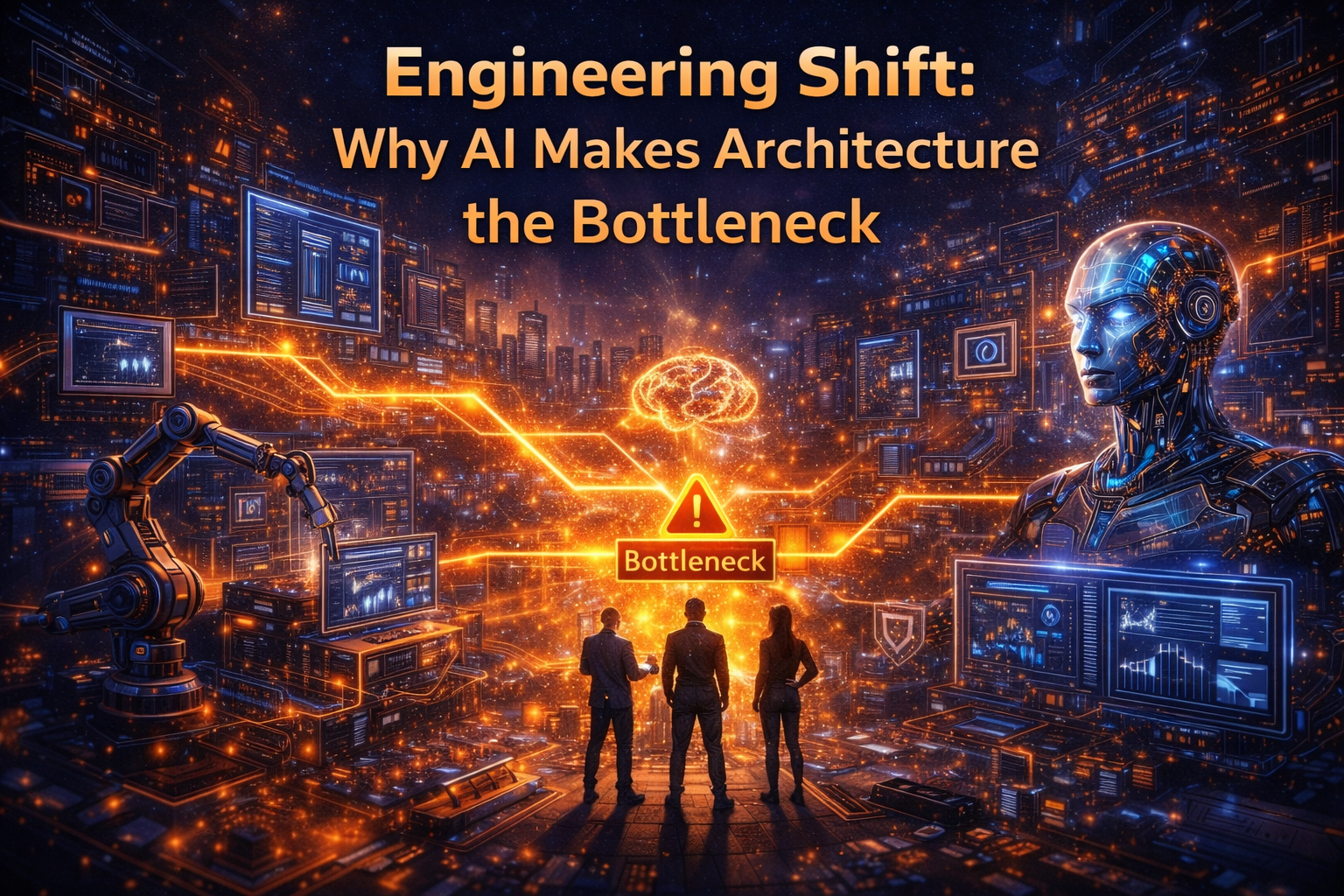

The long-hypothesized shift of AI moving from “co-pilot” to “primary driver” in software development is no longer theoretical. The technical landscape has been irrevocably altered by the confirmation that Anthropic’s internal Claude AI coding tool is now responsible for writing the comfortable majority of the company’s production code. This development is not merely an efficiency gain; it signals an imminent, fundamental re-architecture of the software engineering role itself.
For senior software engineers and tech leads, the immediate concern is where the bottleneck in the development lifecycle now resides. When routine implementation—the core function traditionally performed by mid-level and junior talent—is automated, the constraint moves “up the stack,” away from execution and toward high-level judgment, specification, and decision-making. The ability to architect, review, and rigorously test complex systems is rapidly eclipsing routine code writing skills, demanding an immediate strategic pivot.
TECHNICAL DEEP DIVE: THE O-RING AUTOMATION OF IMPLEMENTATION
The transition from AI as a reactive autocompleter (a typical co-pilot model) to AI as a proactive code generator is rooted in the maturation of Agentic Workflow Architectures. This new paradigm moves beyond simple function completion and enters the realm of complex, multi-step project execution driven by highly descriptive prompts.
The core mechanism involves leveraging the massive context windows and reasoning capabilities of models like Claude Code to manage large, disparate codebase sections simultaneously. Instead of providing line-by-line guidance, the human engineer acts as a High-Level System Prompt Generator. This input is not a command but a detailed, structured specification encompassing functional requirements, desired architectural patterns (e.g., repository structure, dependency injection strategy), data schemas, and non-functional requirements (e.g., latency targets).
The AI agent then executes an O-Ring Automation loop. In this model, the AI performs the bulk of the implementation, integrating across modules, generating necessary boilerplate, and adhering to the specified design patterns. The human engineer’s value is concentrated solely at the critical, high-risk “O-rings”—the points where failure is catastrophic. These points are primarily system definition, interface design, security governance, and validation suite creation. The AI’s output is only as sound as the initial architectural specification, placing tremendous cognitive load and responsibility on the senior personnel defining the system boundaries.
This paradigm requires the underlying system architecture to be increasingly modular and transparent, effectively becoming “LLM-promptable.” Codebases optimized for machine generation prioritize explicit contracts and well-defined interfaces over implicit knowledge, reducing the ambiguity that causes LLMs to introduce subtle yet critical bugs.
PRACTICAL IMPLICATIONS FOR ENGINEERING TEAMS
The rapid ascent of AI as the primary code implementer mandates immediate operational and strategic adjustments for technical leadership:
- Refocus on Architecture and Specification Rigor: Tech leads must prioritize defining system specifications and interfaces with near-formal language rigor. Ambiguous requirements, previously resolved by engineers during implementation, now become direct sources of technical debt introduced by the AI. Development effort shifts from optimizing code implementation to optimizing the clarity and completeness of the system definition.
- Rethinking CI/CD and Code Quality Scrutiny: Traditional CI/CD pipelines, focused on basic linting and unit test coverage, are insufficient. As the complexity and velocity of AI-generated code increase, governance must incorporate advanced static analysis tools capable of detecting subtle architectural misalignments or security vulnerabilities arising from prompt ambiguity. The pipeline must move toward validating system behavior against the architectural spec, rather than merely verifying code functionality.
- Hiring and Staffing Re-calibration: The value of entry-level talent focused purely on implementation tasks is becoming redefined, if not “dubious.” The new organizational need is for senior personnel possessing deep system knowledge and “well-calibrated intuitions and taste” to define the inputs and validate the outputs. Future junior roles will likely focus on prompt engineering, test suite development, and system monitoring, rather than feature implementation.
- Defining the New Developer Experience (DX): Tech teams must rapidly integrate AI agents into the critical path. This means treating the AI tool not as a suggestion box but as a core infrastructural dependency. Documentation, internal tooling, and knowledge bases must be adapted to serve as high-quality context for the LLM agents, enabling them to generate coherent, context-aware code across the entire codebase.
CRITICAL ANALYSIS: BENEFITS VS LIMITATIONS
The shift toward AI-driven implementation presents compelling benefits alongside significant new risks that senior staff must mitigate.
BENEFITS
- Exponential Development Velocity: The most apparent benefit is the massive increase in implementation speed. Routine, known problems—such as integrating a new API client or setting up a database schema—can be executed instantly, allowing product roadmaps to focus entirely on novel, high-value problem solving.
- Consistency and Standards Enforcement: AI agents excel at adhering to established design patterns and coding standards across vast codebases, ensuring high levels of stylistic consistency and reducing the overhead associated with manual enforcement during code reviews.
- Higher Human Cognitive Throughput: By offloading implementation, human engineers can dedicate their entire focus to the most challenging, nuanced problems—system resilience, security architecture, and complex distributed coordination.
LIMITATIONS AND TRADE-OFFS
- Architectural Error Amplification: The primary constraint shifts from implementation speed to architectural correctness. A single flaw in the initial prompt or specification is instantly and perfectly implemented across the system, increasing the cost and complexity of architectural errors discovered late in the cycle.
- System Knowledge Dilution: Over-reliance on AI for routine code generation risks diluting the foundational debugging skills of future engineers, limiting their ability to perform low-level root cause analysis when the inevitable system failure occurs.
- Vendor Lock-in and Cost Complexity: High-performance code generation relies heavily on proprietary, cutting-edge models. Integrating these agents deeply into the CI/CD pipeline introduces risks associated with vendor lock-in, data security, and volatile token usage costs that must be carefully tracked and managed.
- Increased Validation Overhead: While implementation is faster, validation is harder. The engineer must move from debugging specific lines of code to debugging the specification and the resulting prompt ambiguity. This requires building more rigorous, comprehensive, and behavior-driven testing suites to guarantee that the AI’s output meets the high-stakes requirements of production systems.
CONCLUSION
The revelation that a leading AI firm is primarily running on AI-generated code confirms a new reality: implementation is now a largely automated commodity. The primary systemic bottleneck has migrated to architecture, specification design, and validation.
This is not a story about efficiency gains; it is an existential change in required engineering competencies. The immediate strategic impact is clear: Tech Leads must pivot their focus from managing implementation tasks to managing system quality, clarity, and architectural integrity.
Over the next 6 to 12 months, the industry will see a rapid acceleration in the adoption of mature agentic workflows. Demand for highly seasoned software architects and specification writers will surge, while traditional roles centered on feature coding will rapidly diminish or be redefined entirely around oversight and prompting. Teams that fail to adjust their hiring profiles, governance models, and developer workflows—moving from managing code volume to managing system specification quality—will find themselves rapidly falling behind the capabilities of organizations leveraging AI as the primary developer.
Leave a Comment