

The current state of generative AI deployment is primarily governed by two structural inhibitors: high inference cost and pervasive latency. For senior technical leadership, these factors dictate system architecture, budget allocation, and the feasibility of high-volume features. Large Language Models (LLMs), by their autoregressive nature, inherently struggle with synchronous, low-latency interaction, particularly in multimodal contexts like voice. Furthermore, the recurring cost associated with re-processing identical or similar system prompts in Retrieval-Augmented Generation (RAG) pipelines places artificial constraints on scaling and unit economics.
OpenAI’s recent infrastructure announcements—centering on automatic Prompt Caching, the Realtime API, and an expanded Model Distillation Suite—do not represent simple feature additions. They constitute a critical, infrastructure-level intervention designed to fundamentally realign the cost and latency profiles of LLM inference. The core technical thesis is that optimization at the serving layer, specifically reducing redundant computation and enabling protocol efficiency, is the next frontier for achieving scalable, profitable, and genuinely synchronous AI applications.
TECHNICAL DEEP DIVE
The announced capabilities function by tackling architectural bottlenecks across the serving stack, from the transformer internals to the network protocol.
PROMPT CACHING UNDER THE HOOD
The transformer architecture relies on the Key-Value (KV) Cache, where the model stores the intermediate attention keys and values generated during the processing of input tokens. Traditionally, every request, even if using an identical system prompt prefix (e.g., “You are a helpful assistant who strictly follows these rules: [500 words of context]”), requires the model to re-compute these K/V projections for the entire prompt. This prompt processing phase is both time-consuming and expensive.
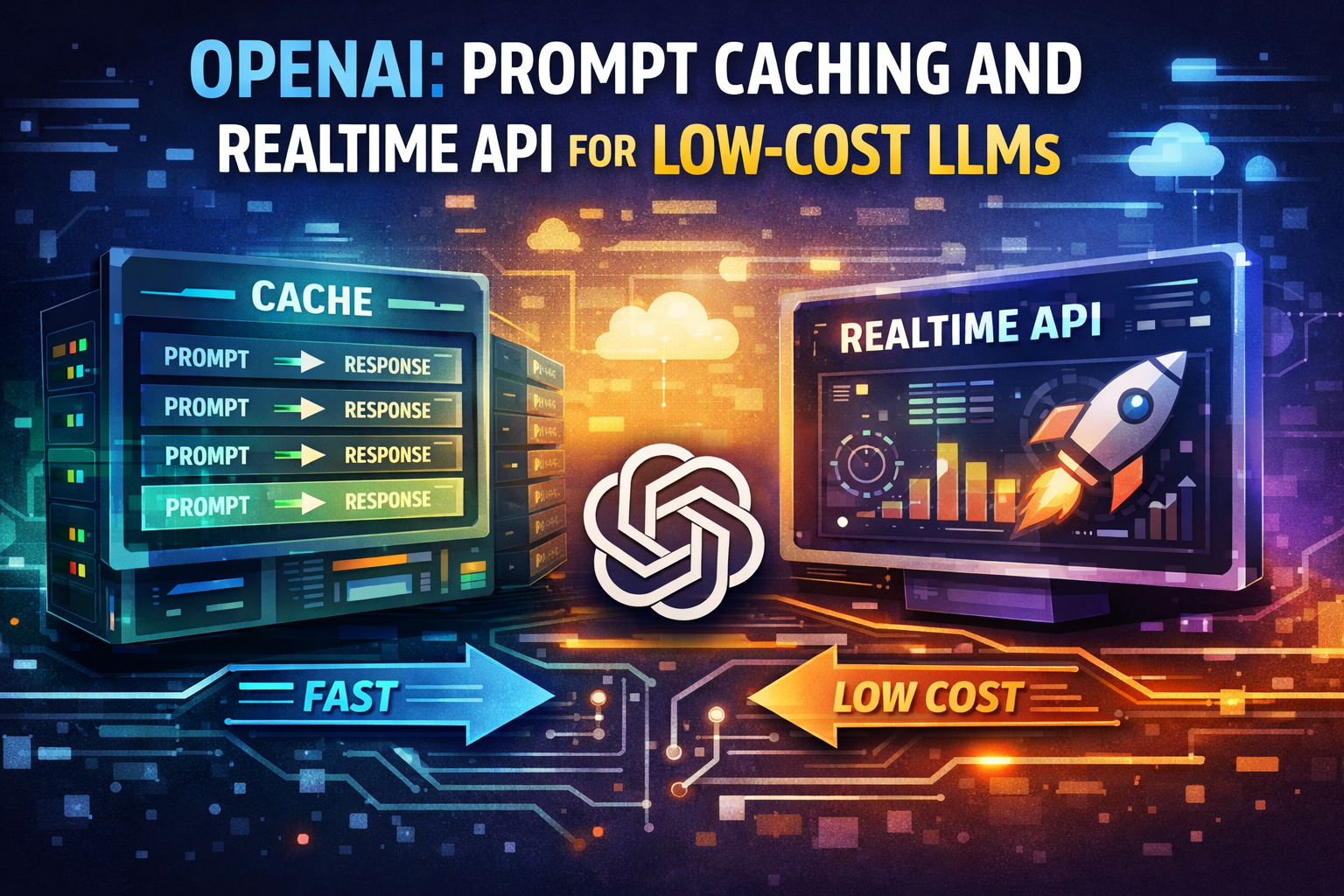
Automatic Prompt Caching, now integrated into the latest GPT-4o models, mitigates this redundancy by persisting the K/V cache segments for common or repeated prompt prefixes across multiple, separate user sessions. When a new request arrives with a recognized prefix, the serving infrastructure bypasses the resource-intensive prompt processing step. Instead, it instantly loads the pre-computed K/V cache from a high-speed, persistent memory store, jumping directly to the faster, sequential token generation phase. This infrastructure-managed optimization is the technical basis for the claimed 50% cost discount and reduced latency for RAG and constrained-generation applications.
THE REALTIME API AND LOW-LATENCY ARCHITECTURE
The Realtime API directly addresses the challenges of multimodal, synchronous interaction, especially speech-to-speech conversational agents. Achieving natural conversation requires end-to-end latency below 300 milliseconds. Traditional API calls over standard HTTP/2 are typically too slow due to handshake overhead and the sequential nature of typical voice processing: audio segmentation, transcription, LLM processing, Text-to-Speech (TTS) generation, and audio transmission.
The Realtime API leverages optimized network protocols, likely utilizing WebSockets or similar persistent connections combined with advanced protocol buffering, to minimize transport latency. More critically, the underlying service architecture employs concurrent processing streams. Transcription of the user’s speech and initial token generation by the LLM are initiated almost simultaneously, with the output being streamed immediately via low-latency TTS. This highly optimized, deeply integrated multimodal pipeline allows developers to build agents that feel genuinely responsive and human-like, a capability previously restricted to highly custom, proprietary infrastructure stacks.
MODEL DISTILLATION AND VISION FINE-TUNING
These features provide MLOps teams with control over model efficiency and specialization. Model Distillation involves using the output of a large, high-performing model (the teacher, such as GPT-4o) to train a smaller, computationally cheaper model (the student). The student model learns to mimic the teacher’s desired behavior on a specific domain, achieving near-frontier performance for that task while benefiting from lower memory consumption, faster inference times, and significantly lower operational cost.
Vision Fine-Tuning expands the standard fine-tuning process to include joint text and image inputs. This is crucial for applications requiring high precision in visual reasoning, such as proprietary object detection in factory settings or highly granular visual search within complex user interfaces, enabling the specialization necessary to replace general-purpose vision calls with tailored, efficient alternatives.
PRACTICAL IMPLICATIONS FOR ENGINEERING TEAMS
COST MANAGEMENT AND UNIT ECONOMICS
The introduction of automatic Prompt Caching immediately impacts the bottom line for applications with high prompt redundancy. Tech Leads must audit existing LLM workloads to identify where standardized system prompts, persona definitions, or RAG context blocks are being repeatedly submitted. For these workflows, the 50% cost reduction can justify the scaling of features previously deemed cost-prohibitive, such as high-volume customer service routing or deeply contextualized in-app search. This shifts the engineering focus from optimizing prompt size to maximizing cache hits.
ARCHITECTURAL ROADMAPS AND SYNCHRONICITY
The Realtime API is an architectural mandate for teams focused on conversational AI. It removes the necessity of complex, high-effort custom streaming and concurrent processing systems. Engineering teams should pivot their roadmaps toward developing genuinely synchronous voice agents. This requires adopting stream-based data handling patterns (e.g., using protocols like gRPC streams or WebSockets) and re-evaluating the user experience flow to accommodate real-time, bi-directional multimodal data exchange. The standard stateless REST API call is no longer the appropriate primitive for advanced conversational interfaces.
MLOPS OPTIMIZATION AND DEPLOYMENT
MLOps engineers now possess a clear, vendor-supported path to optimize deployment. The Distillation Suite encourages a strategic move toward a hybrid model fleet. High-value, complex, or low-volume tasks may remain on the large frontier models (GPT-4o). However, high-volume, well-defined tasks (e.g., classification, simple summarization, standard entity extraction) should be migrated to smaller, distilled models. This specialization reduces the overall Total Cost of Ownership (TCO) for the AI infrastructure while distributing the load and improving the overall system latency profile.
CRITICAL ANALYSIS: BENEFITS VS LIMITATIONS
BENEFITS
- Financial Efficiency: Prompt Caching delivers an immediate and non-trivial reduction in inference cost (up to 50%) for the most common computational bottleneck—processing the context window—directly improving gross margins for high-volume deployments.
- Latency Reduction: The combination of prompt caching (reducing prompt processing time) and the Realtime API (optimizing network protocol and concurrency) dramatically reduces both average and P99 latency, making human-like synchronous interaction viable.
- Customization and Specialization: Vision Fine-Tuning and Model Distillation provide enterprise-grade tools for creating specialized, cost-optimized models that exceed the performance of general-purpose models on targeted tasks.
LIMITATIONS AND TRADE-OFFS
- Cache Hit Rate Dependence: The efficacy of Prompt Caching is entirely dependent on the application’s ability to generate frequent, identical prompt prefixes. Highly dynamic, user-specific prompts will see negligible benefit, requiring engineers to strategically enforce prefix uniformity.
- Vendor Lock-In and Abstraction: Prompt Caching is an opaque infrastructure feature managed entirely by the vendor. While beneficial, it increases reliance on the vendor’s serving technology, potentially complicating future multi-cloud or open-source migration strategies.
- Implementation Complexity: While the Realtime API simplifies low-latency connection, integrating its continuous, stream-based architecture requires more sophisticated client-side logic and connection management compared to traditional stateless HTTP APIs, introducing complexity in debugging and error handling.
- Distillation Effort: Model Distillation is not a zero-effort operation. It requires specialized data science and MLOps effort to curate the training data, manage the distillation process, and continuously monitor the specialized student model’s drift from the teacher model’s performance baseline.
CONCLUSION
These advancements signify the transition of the LLM ecosystem from a research-driven environment focused on maximum capability to an industrial architecture focused on operational viability. By addressing the twin constraints of cost and latency at the infrastructure layer, OpenAI has significantly lowered the economic and technical barriers to deploying generative AI at scale.
The strategic trajectory for the next 6-12 months is clear: Engineering teams will aggressively restructure RAG architectures to maximize the cost savings offered by automatic caching. Concurrently, the Realtime API will catalyze the mass deployment of multimodal, synchronous voice and visual agents, challenging traditional GUI interaction paradigms. Finally, the maturation of the Distillation Suite will lead to a fragmented and optimized deployment landscape, where a tailored fleet of cheaper, faster specialized models replaces many current general-purpose API calls, fundamentally redefining the TCO of AI integration across the enterprise stack.
🚀 Join the Community & Stay Connected
If you found this article helpful and want more deep dives on AI, software engineering, automation, and future tech, stay connected with me across platforms.
🌐 Websites & Platforms
- Main platform → https://pro.softwareengineer.website/
- Personal hub → https://kaundal.vip
- Blog archive → https://blog.kaundal.vip
🧠 Follow for Tech Insights
- X (Twitter) → https://x.com/k_k_kaundal
- Backup X → https://x.com/k_kumar_kaundal
- LinkedIn → https://www.linkedin.com/in/kaundal/
- Medium → https://medium.com/@kaundal.k.k
📱 Social Media
- Threads → https://www.threads.com/@k.k.kaundal
- Instagram → https://www.instagram.com/k.k.kaundal/
- Facebook Page → https://www.facebook.com/me.kaundal/
- Facebook Profile → https://www.facebook.com/kaundal.k.k/
- Software Engineer Community Group → https://www.facebook.com/groups/me.software.engineer
💡 Support My Work
If you want to support my research, open-source work, and educational content:
- Gumroad → https://kaundalkk.gumroad.com/
- Buy Me a Coffee → https://buymeacoffee.com/kaundalkkz
- Ko-fi → https://ko-fi.com/k_k_kaundal
- Patreon → https://www.patreon.com/c/KaundalVIP
- GitHub Sponsor → https://github.com/k-kaundal
⭐ Tip: The best way to stay updated is to bookmark the main site and follow on LinkedIn or X — that’s where new releases and community updates appear first.
Thanks for reading and being part of this growing tech community!
Leave a Comment