

The relentless pursuit of scale in generative AI has recently collided with fundamental economic and engineering limitations. As Large Language Models (LLMs) balloon in size, the computational demand required for both training and inference has escalated into a primary bottleneck, manifesting as crippling Total Cost of Ownership (TCO) and unsustainable energy consumption. Tech leads grappling with multi-billion parameter models have recognized that incremental improvements to existing hardware are insufficient to meet the accelerating demands of the market. This structural challenge requires a foundational infrastructure response.
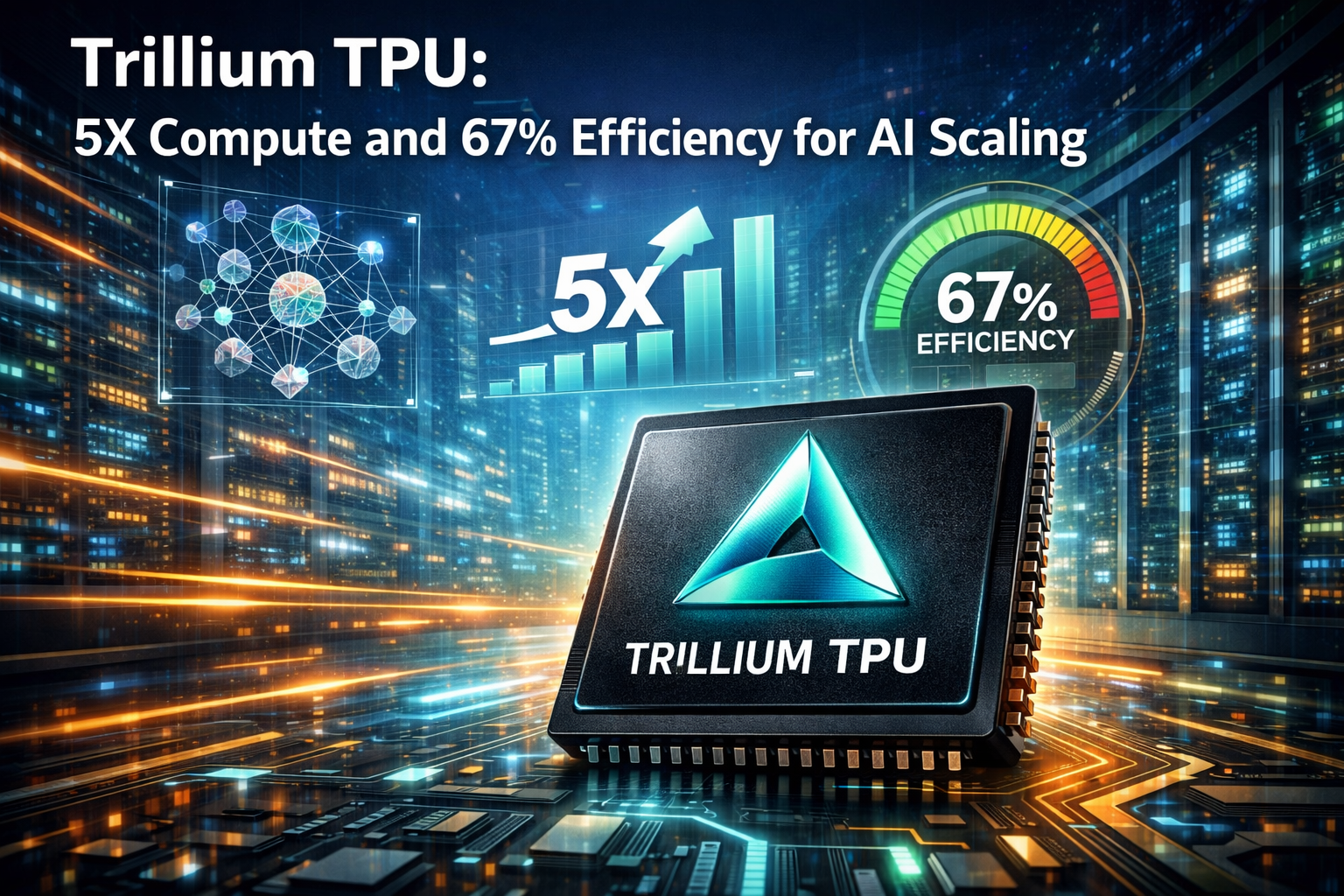
Google’s introduction of Trillium, its sixth-generation Tensor Processing Unit (TPU), is that response. This hardware release is far more than a specification bump; it fundamentally alters the economics of high-demand AI workloads. With a near fivefold increase in peak compute performance per chip compared to the preceding TPU v5e, and a drastic 67% improvement in energy efficiency, Trillium directly addresses the critical constraints of computational cost and thermal density. The technical thesis of this development is clear: by collapsing the time and energy required for computation, Google aims to redefine the accessibility and scalability of next-generation AI agents, immediately impacting resource planning and development roadmaps across the industry.
TECHNICAL DEEP DIVE
Trillium achieves its performance metrics through significant architectural enhancements across three core vectors: compute density, power efficiency, and inter-chip communication bandwidth.
The most critical specification is the nearly 5X increase in peak compute performance. While specific micro-architectural details remain proprietary, this magnitude of performance gain strongly indicates a massive increase in the density and frequency of the on-die Matrix Multiplication Units (MXUs). TPUs are designed for low-precision tensor operations (e.g., bfloat16), which are ideal for deep learning matrices. The 5X gain suggests advances in how the MXUs execute these operations, likely through wider vector units, deeper pipelining, and optimization of the data path between on-chip memory and the MXUs, minimizing costly stalls and data movement penalties. This density increase is crucial because it translates directly into faster training convergence and higher throughput during inference, reducing the wall-clock time required for both phases of the AI lifecycle.
Simultaneously, the 67% efficiency improvement over the TPU v5e is a major engineering feat, tackling the equally severe problem of escalating data center power usage. This efficiency gain is likely the result of employing a more advanced silicon manufacturing process node combined with sophisticated power gating and frequency scaling capabilities tailored for AI workloads. For data center operators and architects, a lower power-per-FLOP metric translates into lower thermal loads, decreased cooling costs, and increased chip density per rack unit—key levers in minimizing operational expenditure (OPEX).
Finally, Trillium’s effective scaling is secured by proportional improvements in interconnectivity. The launch of A3 Mega instances, utilizing Trillium, doubles the networking bandwidth compared to standard A3 instances (which use NVIDIA H100 GPUs). When scaling LLMs across hundreds or thousands of accelerators—forming a TPU superpod—the speed of the inter-chip interconnect (ICI) becomes the definitive bottleneck for training. Distributed training protocols, especially those involving All-Reduce operations necessary for synchronizing gradients across chips, demand exceptional bandwidth. Doubling this capacity ensures that the 5X increase in compute performance can be effectively utilized across the entire superpod fabric, maintaining high utilization rates and minimizing communication overhead.
PRACTICAL IMPLICATIONS FOR ENGINEERING TEAMS
For Senior Software Engineers and Tech Leads, Trillium necessitates an immediate recalculation of technical roadmaps and TCO models. The 5X compute increase means that tasks previously requiring five days of dedicated compute time might now conclude in one day.
- Training and Iteration Speed: The most immediate impact is on the development cycle. Faster training cycles allow engineering teams to pursue more aggressive hyperparameter searches, train larger model variants, or iterate on model architectures more rapidly. This speed drastically reduces the time-to-market for proprietary models and advanced AI-powered features.
- Inference Latency and Cost: The combination of 5X compute and 67% efficiency fundamentally transforms the inference layer. Low-latency, high-throughput serving is essential for integrating sophisticated models, such as advanced Gemini agents or complex code assistance tools, into real-time production environments. Tech leads can anticipate significantly lower p99 latency for high-demand applications, while the efficiency gain dramatically lowers the OPEX associated with running large models in production 24/7.
- System Architecture: The improved networking (A3 Mega instances) empowers architects to design models for greater parallelism. When fine-tuning or deploying large multi-modal models, teams can leverage data parallelism and model parallelism with lower communication penalty, allowing for denser model packing and more effective resource provisioning. This reduces the complexity associated with mitigating network bottlenecks in CI/CD pipelines dedicated to model deployment.
- TCO Recalibration: Tech Leads must now factor the performance uplift into their resource allocation strategy. A shift to Trillium minimizes the required compute hours per epoch, leading to measurable cost savings that offset infrastructure costs. This allows resources to be reallocated from basic training costs toward data curation, feature engineering, and high-value research.
CRITICAL ANALYSIS: BENEFITS VS LIMITATIONS
While Trillium offers compelling advantages, engineering teams must evaluate its introduction with a balanced perspective, considering both the performance gains and the strategic constraints.
Benefits:
- Massive Performance Leap: The near fivefold increase in peak compute per chip is a non-incremental leap that resets industry expectations for compute density and accelerates the potential complexity of deployable AI systems.
- Operational Sustainability: The 67% energy efficiency gain is critical for meeting corporate sustainability goals and maintaining economic viability as AI systems scale up. It transforms the cost structure from purely performance-driven to performance-and-efficiency driven.
- Network Scaling Reliability: The doubling of inter-chip networking bandwidth (in A3 Mega instances) ensures that the computational gains are realized in scaled superpod environments, providing robust, high-throughput communication necessary for large-scale distributed machine learning.
Limitations:
- Vendor Lock-in and Portability: The use of proprietary TPU architecture inherently imposes a degree of vendor lock-in to the Google Cloud ecosystem. Unlike hardware that supports open standards like CUDA, transitioning TPU-optimized workloads to alternative cloud providers or on-premises GPU infrastructure requires significant re-optimization and framework adaptation.
- Programming Model Specialization: Utilizing TPUs to their maximum capacity requires fluency in frameworks optimized for the device, such as JAX or TensorFlow. While these frameworks offer superior performance optimization for TPUs, engineering teams accustomed solely to PyTorch on CUDA may face a steeper learning curve and require specialized skills for effective deployment and debugging.
- Maturity and Availability: As a foundational hardware launch, initial availability and resource allocation for Trillium may be constrained, requiring advanced planning. Furthermore, complex infrastructure requires time to mature its associated software tooling, monitoring, and fault recovery mechanisms, which could introduce initial friction for early adopters.
CONCLUSION
Trillium represents a strategic investment that fundamentally shifts the foundation of cloud-based AI infrastructure. It is not merely an attempt to keep pace but a definitive move to gain a structural advantage in computational efficiency. By tackling the primary generative AI bottleneck—cost and energy—with a 5X performance improvement, Google has effectively raised the performance floor for sophisticated AI development.
Looking forward over the next 6-12 months, this development creates a clear trajectory toward a new generation of enterprise-grade AI applications. The reduced TCO and enhanced performance will empower engineering teams to deploy large-scale, multimodal AI agents and sophisticated reasoning systems (e.g., highly complex code assistants or personalized medical models) that were previously economically non-viable. Tech leaders must integrate the massive efficiency gains of Trillium into their long-term strategic planning, recognizing that computational power is becoming more abundant and less expensive, thereby accelerating the timeline for achieving scalable, high-performance AI in production.


Leave a Comment